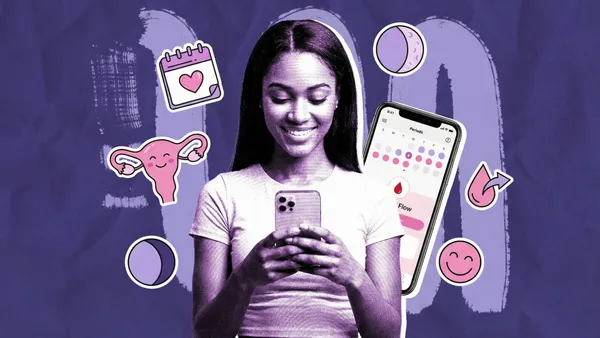
Nearly one-third of women in the U.S. use a period tracking app, and 46% of the Rescripted community tracks their cycle on their phone. It makes sense — logging a few cycles builds a user manual for your body that no one else can hand you.
But since the overturn of Roe v. Wade, the reproductive data sitting inside those apps has become a genuine concern. Your cycle log is, functionally, a digital record of your fertility status. Which app you choose now matters in a way it didn't a few years ago.
Here's what actually makes a period tracker safe, and the eight that clear the bar.
Why period tracking apps matter
Period tracker apps can feel like they’re just there to tell you when to restock tampons, but they can be way more useful than that. When you log a few cycles, you start building a little “user manual” for your body, which is kind of iconic.
They help you understand your cycle phases, not just dates. Your menstrual cycle includes distinct phases like the follicular phase, ovulation, and the luteal phase, each driven by hormonal shifts that influence energy, mood, appetite, and focus. Medical researchers increasingly describe the menstrual cycle as a vital sign of overall health, not just a reproductive event, according to the American College of Obstetricians and Gynecologists (ACOG). Tracking over time helps you recognize what’s typical for you and what’s changed.
They support smarter decisions around fitness, sleep, and nutrition. Hormonal changes across the cycle can affect things like resting body temperature, sleep quality, and perceived exertion during workouts. Research published in 2021 in The International Journal of Environmental Research and Public Health suggests that some people notice performance and recovery differences depending on cycle phase. A tracking app helps you spot your own trends so you can plan workouts, rest days, and bedtime routines with more intention.
They introduce the basics of cycle syncing, without the pressure. Cycle syncing isn’t about rigid rules or pink-washing productivity. It’s simply noticing patterns and adjusting when it feels supportive. Research by CNN published in the National Library of Medicine in 2022 noted that while cycle syncing isn’t one-size-fits-all, awareness of hormonal fluctuations can help some people feel more in tune with their bodies and reduce frustration when energy dips.
They make symptom tracking easier and more useful. Logging cramps, spotting, headaches, mood changes, or GI symptoms creates a clearer picture over time. That record can be helpful if you’re advocating for yourself in a medical setting, especially since clinicians often rely on patient-reported cycle history when evaluating concerns like irregular periods or severe pain.
A quick note of honesty: most period apps are better at tracking patterns than perfectly predicting ovulation, especially when they rely on calendar data alone. A 2022 survey published in Women’s Health London showed prediction accuracy varies widely between users. That doesn’t make apps useless, it just means they’re tools for insight, not crystal balls.
And because these apps can reveal so much about your body and your life, it’s worth paying attention to what happens to that data once you hit “log.” Privacy matters, too.
It’s also worth noting that period tracking apps aren’t designed for those using birth control. As Dr. Caledonia Buckheit, OB/GYN explains: “Menstrual cycle tracking for insights into different phases of the cycle, ovulation etc can only be done by those who are not on a systemic hormonal birth control method. If you are on the pill, patch, ring, depo shot, nexplanon, your bleeding timing is dictated by the hormonal birth control, not by endogenous hormone changes.”
Are period tracking apps safe?
Short answer: it depends on the app.
There's nothing medically risky about logging your cycle. Tracking periods, symptoms, and patterns is widely recognized as useful for understanding your reproductive health. The concern isn't the tracking — it's what happens to the data after you hit "log."
Researchers have repeatedly flagged health apps, including period trackers, for sharing sensitive data with third parties. A 2024 study in Computer Law & Security Review found that many popular fertility and period apps transmitted user data to outside companies, sometimes without clear disclosure. And a 2020 study in Perspectives in Health Information Management documented how consumer health apps fall outside traditional medical privacy laws entirely.
That last point is the one most people don't know: HIPAA does not apply to period tracking apps. Your OB/GYN is bound by it. The app on your phone isn't.
Why this matters more than it used to. Because these apps record when your period starts and stops, when you ovulate, and when you have sex, they can indicate pregnancy — and a change in that pattern can indicate the end of one. Depending on an app's privacy policy, that data could be sold to a third party or subpoenaed. Apps do cooperate with law enforcement during criminal investigations, and Flo has previously come under fire for sharing user data with Facebook.
The exposure isn't limited to period apps, either. Location data from any app on your phone, and your search history, can tell a similar story.
The reassuring part: safer options genuinely exist. Some apps collect almost nothing, let you track anonymously, store everything locally on your device, or state plainly that they don't sell or share health data. Knowing what to look for is most of the work — and that's next.
What to look for in a safe period tracker
Not all period trackers are built with your privacy in mind, so it helps to know what “safe” actually looks like before you download anything. Think of this as your checklist for apps that protect you, not just your cycle.
EU-based apps and GDPR compliance
The EU has the strictest privacy regulations in the world. European law honors its community’s health data more than any other region, so using an app that was developed under the European Union is one of the safest bets.
Depending on where you live, too, you may be subject to additional protection. For example, California, Colorado, and Virginia residents have additional rights over their data, but it still doesn’t fully compare to the GDPR (General Data Protection Regulation) in the EU.
Subscription model vs. free apps
When you pay for the use of an app, you become the main customer, not advertisers or other third parties they could be selling your data to. If you want your data to be secure, paying for it is a great place to start, though be sure to read any privacy policy you sign, regardless of digging further into which rights you’re giving up when you decide to use their platform.
It’s also worth saying this out loud: many safe, free period tracking apps do exist. Some companies choose not to sell data at all, regardless of pricing. Free doesn’t always mean risky, and paid doesn’t always mean protected.
Look for public privacy statements
If a company genuinely cares about data privacy, they will make it known in their core product messaging and/or include it as a section in their footer, so you can read more about how they plan to protect your data.
Look on their site for information on what data they collect, what data they keep and for how long, how and where that data is stored, and how it can potentially be shared.
Companies should state that:
They don’t allow third-party tracking or resale to third parties
They enable you to use the app without location services turned on
Your data remains locally stored on your device, not remotely
If there’s a messaging or communication element involved, they utilize end-to-end encryption, meaning only the sender and receiver can access the message, and there’s no possibility of it being breached while in transit
They offer a clear way to delete any data that’s been stored
Data privacy features
Following the Dobbs decision, more apps have rethought their privacy policies and the data they collect from users in general, resulting in new features such as Anonymous Mode from Flo Health. This lets users enter data into the app without adding their name, email, or other technical identifier, making it impossible to connect data to someone once that feature is activated.
Other privacy-forward features to look for include optional passcodes or biometric locks, limited analytics tracking, and the ability to opt out of data sharing entirely.
Local vs. Cloud storage
Generally, it’s recommended to use apps that store data locally on your device as opposed to the cloud, where it’s more accessible. When your data stays on your phone or tablet, the company can’t sell it, share it with third parties, or hand it over to a legal party in the case of a security breach at the company.
To go a step further with this, you can also disable location services for that app in particular, or use incognito mode when searching on the web through browsers like Google Chrome. The Electronic Frontier Foundation has a much more robust list of how you can protect your search history and online activity.
A note on encryption, since apps market it heavily: end-to-end encryption is the strongest form, meaning data is scrambled on your device and can only be read by the intended recipient — not the company, not advertisers, not anyone intercepting it. Very few period apps actually do this for cycle data. Most use encryption in transit and at rest, which helps but isn't the same thing. Apps that store everything locally — Euki, drip., Lady Cycle, Cycles — sidestep the question, since there's no cloud to breach.
The 8 best safe period tracker apps
These period tracker apps meet the safety criteria outlined above, meaning they prioritize privacy, limit data collection, and give users real control over their information. This list was curated based on publicly available privacy policies, independent reporting, and how closely each app aligns with GDPR level protections and best practices for sensitive health data.
No app is perfect for everyone, but these are widely considered some of the safest options available right now.
1. Cycles
Cycles is a minimalist period tracker designed with privacy first, not ads.
Users can use the app without creating an account
Stores your data locally on your device
If you decide to create an account, you can hide your email from the company, meaning they won’t be able to link anything back to your email address
Users have the option to delete their data within the app without having to contact the company to do so
The company is based in Sweden and thereby operates under GDPR guidelines, meaning they have to abide by the strictest data privacy standards in the world
Best for: People who want a simple, private tracker without logins or cloud storage.
Price: Free, with optional paid features depending onthe platform.
2. Stardust
Stardust is vocal and transparent about privacy, with an entire section of their site dedicated to data protection.
They have a landing page on their site dedicated to data privacy, stating: they have a team of dedicated lawyers and an upgraded security system managed by Rownd, a privacy-first authentication platform, and they’re committed to continually investing more resources into in-class protection for all users
No third-party tracking or sales
All user sessions are 100% anonymous
They don’t collect IP addresses
It’s impossible to connect any user information to specific logins because they have no way of knowing which data set belongs to which person (read more about their in-depth privacy policy here)
Best for: Users who want strong privacy with a more playful, modern interface.
Price: Free with optional premium subscription.
3. drip. Period Tracker
drip. is an open source app built by and for people who care deeply about data ownership.
Stores your data locally on your device
No third-party tracking and sales
All your data is protected by a PIN established by you
Open source, meaning its code can be publicly audited
Best for: Privacy-focused users who appreciate transparency and open source software.
Price: Free.
4. Euki
Euki was built with digital safety in mind, especially for reproductive health tracking.
Option to establish a PIN when logging in that’s not linked to any of your personal information, such as your email address or phone number
Stores your data locally on your device
No third-party tracking or sales
You can delete data on demand or schedule sweeps to remove sensitive information from your device
Best for: Users who want maximum control and quick data deletion options.
Price: Free.
5. Lady Cycle
Lady Cycle is designed for offline use, which dramatically reduces privacy risks.
Questions Women Are Asking
Stores your data locally on your device
No third-party tracking or sales
Recommended by independent security experts
Don’t need a personal login or internet connection to use the app (so there’s no way to link your personal info to the data collected)
Best for: People practicing fertility awareness who want an offline-only option.
Price: Paid app with a one-time purchase.
6. Spot On (by Planned Parenthood)
Spot On is built by a nonprofit, which changes the incentives entirely.
Can remain fully anonymous (there’s no need to ever make an account)
Made by the non-profit, Planned Parenthood, so there’s no economic incentive behind the product
No third-party tracking or sales
Best for: Users who want a trustworthy, nonprofit-backed tracker with zero monetization pressure.
Price: Free.
7. Period Plus
Period Plus focuses on transparency around how anonymized data is used.
Stores your data locally on your device
No third-party tracking or sales
They transparently stated they only use user data in a de-identified form for the sake of improved product development and statistical studies to prove product efficacy
Best for: People comfortable with anonymized data being used for research, but not marketing.
Price: Free with optional paid features.
8. Clue
Clue is one of the most well-known period trackers and operates under EU law.
Because they’re based in the EU, they’re required by GDPR to protect their users' health data to the strictest degree in the world; they’re not allowed to disclose their users’ data, regardless of where they live
They transparently stated they only use user data in de-identified form for the sake of improved product development and statistical studies to prove product efficacy
Strong scientific focus and medical partnerships
Best for: People who want a research-driven app with strong regulatory oversight.
Price: Free with a premium subscription option.
Women-owned period trackers
For some people, who builds the app matters as much as what it does. Women-founded trackers are often shaped by lived experience rather than a market gap — not a guarantee of safety, but it can be reassuring to know the people behind the tech understand cycles from the inside.
Three apps on our list qualify:
Clue: Co-founded by Ida Tin, the Danish entrepreneur widely credited with defining the femtech category.
Stardust: Co-founded by Rachel Moranis and Molly Young in 2020, and unusually vocal about reproductive autonomy and cycle data in a post-Dobbs landscape.
Euki: Built by Ana Maria Ramirez and Melinh Rozen as a mission-driven project focused on protecting vulnerable users.
Best period tracking apps for specific needs
Different bodies, different seasons of life, different goals. A good period tracker should meet you where you are, whether you want something free and simple, support through perimenopause, fertility insights, or a way to share cycle info with a partner. Here’s how some of the safest options fit specific needs.
Best free period tracking apps
If you want a period tracker that doesn’t cost anything and doesn’t monetize your data, a few options stand out.

Spot On is completely free and built by Planned Parenthood, a nonprofit focused on sexual and reproductive health. You get period tracking, symptom logging, and educational content without creating an account or sharing personal identifiers. The tradeoff is fewer advanced predictions or analytics, but for many people, that simplicity is the point.
drip. is another fully free option. It stores data locally, protects entries with a PIN, and doesn’t use ads or trackers. The interface is bare bones, but if privacy and transparency matter more than design, it delivers.
Euki is also free and designed with safety first. It allows local storage only and offers quick deletion tools, which can feel especially reassuring. What you give up is a more detailed cycle prediction, but you gain control.
Best period tracker apps for teenagers
For teens, privacy, education, and age-appropriate language matter more than polished features. The American Academy of Pediatrics emphasizes confidentiality and clear health education for adolescents, especially when it comes to reproductive health.
Spot On works well for teens because it explains periods, symptoms, and cycle basics in plain language and can be used completely anonymously. It doesn’t pressure users to share data or upgrade, which is important for minors.
Clue can also be appropriate for older teens. It offers science-based explanations and strong privacy protections under EU law. Some features require a paid plan, but basic tracking and education are available for free.
Best period tracker for perimenopause
Perimenopause often means cycles become unpredictable, and symptoms go beyond bleeding alone. Tracking bleeding patterns, sleep, mood, and physical symptoms can be helpful during this transition.
Clue is one of the best options here. It handles irregular cycles without forcing predictions and allows tracking of a wide range of symptoms like hot flashes, sleep changes, and mood shifts. It’s research-driven, which some users find reassuring.
Cycles can also work well during perimenopause if you prefer simplicity. It doesn’t assume regular cycles and keeps data local, though it offers less educational content specific to menopause.
Best period and ovulation tracker for fertility
If you’re trying to conceive, ovulation tracking becomes more relevant, but it’s worth knowing that app predictions aren’t perfect. Research published in Current Medical Research and Opinion in 2018 has shown that ovulation prediction accuracy varies widely between apps, especially when based on calendar data alone.
Clue offers fertility-focused modes and ovulation estimates with clear explanations of confidence ranges. It’s best used alongside other fertility awareness tools rather than as a standalone predictor.
Lady Cycle is designed specifically for fertility awareness methods. It works offline and stores data locally, but it does require users to understand and actively apply fertility awareness principles, which can feel like a learning curve at first.
Best cycle syncing app
Cycle syncing is about noticing how energy, focus, appetite, and recovery shift across your cycle and adjusting expectations accordingly. It’s not a rigid system, but it can help some people feel less frustrated by hormonal changes.
Stardust leans most into this approach. It offers phase-based insights and lifestyle suggestions tied to mood and energy patterns. These aren’t medical instructions, but they can help users reflect on patterns. Many people pair app use with books like In the FLO by Alisa Vitti to deepen their understanding.
Period tracker for couples/husbands
Some people choose to share cycle data with a partner for planning, fertility, or emotional support. Sharing should always be optional and consent-based.
Cycles allows optional partner sharing without requiring the partner to create a full account. This can help with planning while keeping control over what’s visible.
Stardust also offers partner features, designed to support communication around cycles and mood changes. For some couples, this builds empathy. For others, it’s unnecessary, so the ability to opt in matters.
How accurate are period tracking apps?
Period tracking apps can be fairly accurate at predicting your next period, especially if your cycles are regular and you log data consistently. Where things get shakier is ovulation and fertile window prediction. Multiple reviews, including research published in Women’s Health (London) in 2022, have found that many apps rely heavily on calendar-based algorithms, which don’t reliably reflect what’s actually happening hormonally in a given cycle. That means predictions can be off, sometimes by several days.
Accuracy depends on two big things: your input and the app’s algorithm. Apps work best when you log bleeding start and end dates every cycle and track symptoms consistently. Missed entries, irregular logging, or only opening the app when something feels wrong all reduce reliability. On the app side, tools that allow additional inputs like basal body temperature, cervical mucus, or ovulation test results tend to offer better fertility insights than calendar-only trackers, but even those aren’t perfect.
As Dr. Buckheit explains, “The calendar-based algorithms essentially take your logged data, average your cycle length, and subtract 14 days from the average cycle length to give you the predicted day of ovulation. Because sperm can live in the female reproductive tract for up to 5 days, these apps will generally highlight the 4 days leading up to and the day after predicted ovulation as the ‘fertile window’.”
There are also real-world limits no app can solve. Stress, illness, travel, intense exercise, postpartum changes, perimenopause, PCOS, and thyroid conditions can all shift cycle timing. An app can’t tell whether a delayed period is a one-off disruption or a medical issue. That’s why researchers consistently caution against using period apps alone to avoid pregnancy or to assume ovulation timing with certainty, unless they’re part of a clinically studied fertility awareness method.
You can improve accuracy by logging regularly, tracking more than just dates, and treating predictions as estimates rather than promises. Dr Buckheit digs deeper: “If you are trying to avoid pregnancy, use a method of birth control throughout your whole cycle, but maybe consider doubling up (adding condoms or Phexxi, for example), during the ‘fertile window.’ If you are TTC, intercourse every other day throughout the middle of your cycle (not just the highlighted days), could increase your odds of conceiving.”
Most importantly, know when to step away from the app and check in with a clinician. The menstrual cycle is a vital sign, so sudden changes matter. Heavy bleeding, bleeding between periods, missed periods for several months, or symptoms that feel new or intense are reasons to get medical advice rather than trusting an algorithm. Apps are great for spotting patterns and supporting conversations, but they’re not a diagnosis, and they’re definitely not a crystal ball.
How to use period tracking apps safely
Choosing a privacy-focused app is a great start, but how you use it matters just as much. A few simple habits can significantly reduce how much personal information is exposed, especially when you’re tracking something as sensitive as your menstrual cycle.
Turn off location services for the app: Most period trackers don’t need your location to function. Disabling location access limits the amount of metadata tied to your cycle data and reduces the risk of it being linked back to you through movement patterns.
Use incognito or private browsing when researching cycle or fertility topics: Searches about periods, ovulation, pregnancy, or miscarriage can reveal a lot about your life stage. Using private browsing helps reduce how much of that information is logged or associated with your broader search history.
Avoid linking the app to social media or other accounts: Connecting a period tracker to platforms like Google, Apple, or social apps can make it easier to associate your health data with your identity. Using the app as a standalone tool keeps those data streams separate.
Delete your data regularly: If the app allows it, clear old entries or set reminders to wipe data you no longer need. This is especially useful if you’re tracking temporarily, like during TTC or after a major life change.
Use anonymous mode or no account mode when available: Some apps allow you to track without entering an email, name, or other identifiers. Turning this on makes it much harder for data to be connected back to you, even internally.
If you want to go deeper, the Electronic Frontier Foundation has a practical, plain language guide to protecting your digital privacy, including steps specifically relevant to reproductive health searches.
Period tracking apps can be genuinely helpful tools. Using them safely just means staying intentional about what you share, what you connect, and what you keep.
Your cycle, your data, your call
Period tracking apps don’t have to be all or nothing. You don’t need to ditch tracking altogether to protect your privacy, and you don’t need to hand over intimate details about your body just to understand your cycle better. Safe options exist, and when you choose thoughtfully, you can keep learning what’s normal for you and what’s changing, without feeling watched.
If you’ve been on the fence, this is your nudge to pick one app that fits your needs and give it a try. Start small. Log a few cycles. Notice patterns. You don’t have to be perfect or track everything to get value from it.
One important reminder: privacy policies aren’t set in stone. Apps update, companies evolve, and data practices can change. It’s worth checking in on an app’s privacy policy from time to time so you stay informed about how your information is handled.
Your cycle is a powerful source of information. You deserve tools that respect that. If you’re ready, download one of these safer period tracking apps today and start tracking in a way that feels supportive, informed, and fully on your terms.