


Emmy Hayes Condon
Your daily guide to feeling, looking, and living your best.
The Ultimate Lip Care Routine: Hydration, Collagen & Plumping Tips That Work
Let's talk lips, babe — because they deserve way more love than a chapstick swipe before bed. Your lips don't have oil glands like the rest of your face, which means they dry out fast and show age early if you're not paying attention. The good news? A little consistency goes a long way.
Start with hydration: look for balms with humectants like glycerin or hyaluronic acid combined with barrier-supporting emollients — think shea butter or ceramides — to keep that moisture barrier strong morning and night. Gentle exfoliation matters too; buffing away dry, flaky skin with a soft lip scrub helps your other products actually sink in instead of sitting on the surface.
Now for the fun part: plumping. Collagen production naturally declines starting around age 25, which is why lips can look thinner over time. To support that from the outside, peptides and collagen-boosting ingredients work over time to improve your lips' natural structure and fullness — no instant tingle, just steady, cumulative results. If you want that fuller look now, hyaluronic acid draws moisture from the air and holds it in your lips, making them look plumper and smoother.
Layer smart: hydrating serum first, plumping gloss on top, SPF balm for daytime protection. So pucker up!
Why You Feel Off in Fall and Winter — And How to Feel Like Yourself Again
Let's talk about how the sun is ghosting us right now. One minute it's summer, the next you're leaving work, and it's already pitch black outside, and your body is like, "Wait, is it bedtime? Should I be hibernating?" Same, honestly.
If you're feeling a little more sluggish, a little more "meh," or just generally out of sync as the days get shorter — you are so not alone. Seasonal shifts genuinely mess with our internal clocks, our energy, and our mood (hi, SAD, we see you), and pretending otherwise doesn't help anyone. So instead of white-knuckling our way through fall and winter, let's get cozy with some actual strategies.
Some ideas that come to mind: light therapy lamps that trick your brain into thinking it's still July, the movement-mood connection (even a 10-minute walk counts, promise), upping your vitamin D intake, and the small daily rituals that keep you feeling like you even when the sky is doing its moodiest impression yet.
It’s also important to stay "in the mood" — for connection, for joy, for showing up for yourself — when everything in you wants to crawl under a blanket and log off. Spoiler: it's less about forcing positivity and more about giving yourself permission to adjust, rest, and find little pockets of light anyway.
So grab your coziest sweater and your favorite warm drink. Let's brighten these darker days together.
Ask Clara:

"What is Seasonal Affective Disorder?"

"I Work in Tech" Used to Be a Flex. Now It's a Dating Dealbreaker.

Okay, we need to talk about this. Wired just dropped a story on tech bros (yes, the loaded ones) and dating, and it's basically a group chat screenshot come to life. Turns out being a "visionary founder" doesn't hit the way it used to.
One guy working at Palantir told Wired his dates would question his morals as soon as he mentioned where he worked — one date even called him the devil. Another told the outlet that he's stopped bringing it up entirely because people "get nervous" and the responses can get pretty ugly. Even guys who consider themselves politically moderate said they're getting side-eyed and lumped in with a vibe they don't actually subscribe to.
So what changed? A professional matchmaker put it perfectly to Wired: a decade ago, working in tech signaled innovation and ambition. Now it signals something closer to "causing the breakdown of society" — think AI anxiety, job displacement, privacy invasion, and outsized political influence.
Basically, "I work in tech" used to be a flex. Now it's a red flag detector.
We're not saying every person in tech is the problem (truly, not every founder is trying to colonize Mars). But this piece is a good reminder that what reads as "ambitious" or "successful" on a dating profile is shifting — and values, ethics, and how someone actually treats people matter way more than a fancy job title ever will.
Read the full story on Wired — it's juicy.
What Is Cozy Cardio? The TikTok Trend Taking Over Fall Workouts

Hot girl walk, we love you, but it's getting cold out, and cozy cardio is having a full moment. The vibe? A brisk fall morning, cozy leggings, warm light, and a protein coffee in hand.
And it's not just cute — a study following over 2,000 adults for 11 years found that hitting around 7,000 steps a day lowered the risk of death by 50% to 70%. So yes, shuffling around your living room in slippers genuinely counts. Fitness pros are also pointing out the catch: cozy cardio's gentle pace means you'll want to pair it with higher-intensity sessions for real heart-health gains, and it's easy to get so relaxed you forget you're supposed to be moving. Balance, babe.
Ready to build your own cozy cardio moment? Here's your starter kit:
Walking pad + your comfort show – think fall rom-coms or a true crime rewatch
Candlelight or fairy lights instead of harsh overheads
A warm drink — pumpkin spice latte, cider, or protein coffee everyone's obsessed with
Soft layers — leggings, an oversized hoodie, fuzzy socks
A podcast or audiobook for days you want to zone out completely
Gentle stretching or yoga flow on rainy, can't-even-walk-pad days
Cute, cozy, and actually good for you? We're in.
Spicules Explained: Benefits, Best Products, and Why This K-Beauty Trend Tingles

The skincare thing everyone's suddenly obsessed with: spicules. Yes, that's a real word, and no, it's not as scary as it sounds. Microspicules are tiny, needle-shaped structures derived from purified sea sponge — basically microscopic silica shards that are invisible to the eye but do a lot of work once they hit your skin. They create micro-channels in the skin, sparking a bit of controlled micro-trauma, kind of like traditional microneedling, except it's suspended in a serum. That's why people call it "liquid microneedling."
So why the tingle? That prickly, temporary sensation is the spicules creating tiny pathways so your other actives — niacinamide, hyaluronic acid, centella, peptides — can actually sink in and do their jobs better. The payoff: refined texture, smaller-looking pores, more radiance, and firmer-feeling skin. Just don't go overboard — a little tingle is normal; a lot means back off.
Ready to try it? Here's where to start:
VT Cosmetics Reedle Shot(50, 100, or 300) — the OG cult favorite, great for beginners since it comes in different strengths
medicube Exosome Shot PDRN Spicule Serum— pairs spicules with exosomes and salmon DNA for extra glow
Rael Microcrystal Activated Serum 2000— niacinamide-forward, great for pore refinement
Start slow, patch test, and let your skin adjust. Your glass-skin era awaits.
Curl Up With a Good Book: It's Basically Self-Care

I have news that lets you feel great about that cozy reading nook. A new University of Cambridge review found that reading for pleasure may boost memory, empathy, and mental health; reduce stress; and help reduce cognitive decline.
Even better, the researchers say it can improve health and wellbeing at any age, regardless of reading material. Romance, thrillers, graphic novels? All count! One of the study's authors points to the secret ingredient: pleasure. Read for enjoyment, and you'll read more often and for longer. Translation: no guilt, no homework, no "shoulds."
The research also found that reading for pleasure early in life was linked with better attention and memory, and with more sleep and less screen time. And Sahakian says it's never too late to start.
So swap a doomscroll for a chapter tonight. To get you going, here are some of the fall releases we're most excited about.
Fall Reads to Add to Your Stack
Exit Party by Emily St. John Mandel
Music Against the Night by Yiyun Li
Fair Ones by Lydia Millet
Heavy Cream by Sarah Blakely-Cartwright
Family Friends by Chloë Ashby
Hollywood, Ending by John Green
The Undercover Bookshop by Katherine Reay
The Oxford Guide to Scandal and Lies by Kate Westbury
Can Meditation Be Harmful? The Latest Conversation
I've got a meditation app on my phone and a long-standing assumption that it can only help. So The Atlantic's new piece, "The Dark Side of Mindfulness," made me sit up. (Reporter Olga Khazan also talks it through on a podcast episode.)
The story follows Willoughby Britton, a psychologist and meditation teacher who set out to study the practice's benefits; what she found alarmed her. Meditation is a multibillion-dollar industry pitched as a remedy for anxiety, pain, and addiction. Still, for some people it can cause severe, lasting side effects, including depression, anxiety, and even acute psychosis. One study found that about 10% of meditators experience some adverse effect.
Before you toss your meditation cushion, keep in mind - there's nuance. Researcher Richard Davidson says meditation is fairly benign for most people, and that skipping it may carry more risk than doing it. But he also says people with serious psychiatric conditions should practice only with a mental-health professional who meditates too. That's a big deal when so many of us are following an app alone at 11 p.m.
My takeaway: stay curious, not scared. Start small. If a practice leaves you feeling worse, don't just push through. And if you have a mental health history or are eyeing a long retreat, talk with a professional first.
Anti-Blush Makeup Trend: What It Is and How to Wear It

Your blush drawer is about to get a plot twist. Anti-blush is everywhere right now, and no, it doesn't mean skipping blush. It's a wash of warm brown that gives you a muted, moody look, and it's a full U-turn from the Barbie pinks and "blush blindness" of recent seasons. Think dusty mauves, taupes, beiges, and soft browns, some so neutral they could pass for bronzer or contour.
So how did we get here? The conversation traces back to creator Kim Senser (@unsensered) and one very viral shade, MAC's Film Noir Buff. Since then, the definition has gotten a little fuzzy, but the vibe is what matters: cheeks that look naturally flushed, like you're not wearing blush at all. Because the colors are low in saturation, they can double as blush and contour.
The best part? You may not need to buy anything. You can mix a custom shade from products you already own. Your mauve and brown blushes are officially having a moment.
Anti-Blush Picks to Try:
MAC Skinfinish Colourstruck Blush in Film Noir Buff: The one that started it all, described by the brand as a rich, warm chocolate. It's reportedly sold out everywhere, so keep an eye out for restocks.
VERSED Everything Balm in Hint: A bronzey plum with a pearl-infused formula that gives a luminous flush so that you can skip highlighter.
Morphe Cheek Tints Multi-Finish Face Trio in Honeymoon Suite: A bronzey brown that works well on deep skin tones, with a sheen that can double as a highlighter.
Tower 28 GetSet Blur + Set Matte Powder Blush in Long Beach Iced Tea: A makeup artist favorite that works as both blush and bronzer.
Rare Beauty Soft Pinch Liquid Blush in Encourage: A pop of mauve color.
Why September Feels Like New Year's (And How to Use That Energy)
January 1st has never actually felt like a fresh start to me. It's cold, it's dark, and by the time the ball drops, I'm already exhausted from the holidays. But late August/early September? That's when I feel it. That itch to buy a new notebook, rearrange my desk, and pretend I'm about to walk into homeroom with a color-coded binder and main character energy.
Something about back-to-school season hits different. Maybe it's nostalgia, maybe it's the shift in light, maybe it's years of conditioning — but every September I do a full life audit. New to-do list system. New morning routine I'll keep for exactly twelve days—a sudden, deep need to label things.
And this year, my feeds are extra loud with it — everyone's talking about the "90-day reset," that social trend where you treat the last quarter of the year like your own personal season finale. New habits, new goals, a clean runway into January instead of scrambling to catch up once the holidays hit.
I love this for us, honestly. There's something so much more forgiving about a fall reset than a January one — no pressure, no resolutions, just... a vibe shift. A permission slip to reorganize your life because the air got a little crisper.
So here’s to actually using that back-to-school energy — without burning out by Halloween. Let's do it!
Ask Clara:
"How do I schedule more time for myself?"
Rec Leagues Are Back: Why Adults Are Ditching the Gym for Kickball
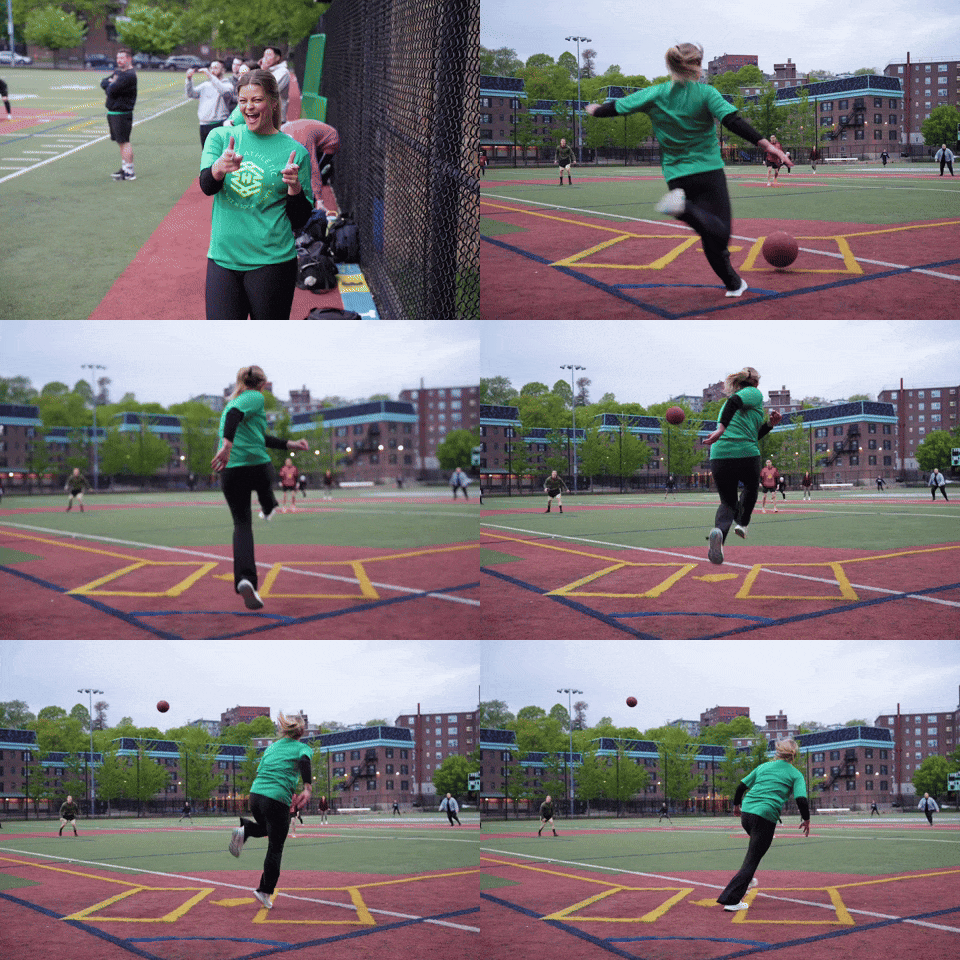
Adult rec leagues are having a full-blown moment, and honestly? It makes so much sense. Remember when "working out" meant dragging yourself to a silent gym, staring at a wall while you did reps, and leaving feeling more drained than when you walked in? Yeah, we're over that too.
Grown-ups everywhere are trading solo workouts for kickball, dodgeball, and rec soccer leagues, and the vibe check is real. Turns out, when you commit to show up because your team is counting on you, you do. No more bailing on leg day because "I'm tired." Your teammates need a fourth for kickball, so you're there, and suddenly you've moved your body, laughed way too hard at a bad throw, and made actual friends — all without it feeling like a chore.
It's giving nostalgia, too. That "recess energy" we didn't know we were missing since, like, sixth grade. Community and competition might be the secret sauce to sticking with movement long-term, way more than any fitness app streak ever could.
So if your workout routine has felt a little flat lately, maybe the answer isn't a new gym membership — it's a jersey and a Wednesday night game. Grab your friends, sign up for a league, and let's get back out there. Trust us, your body (and your social calendar) will thank you.