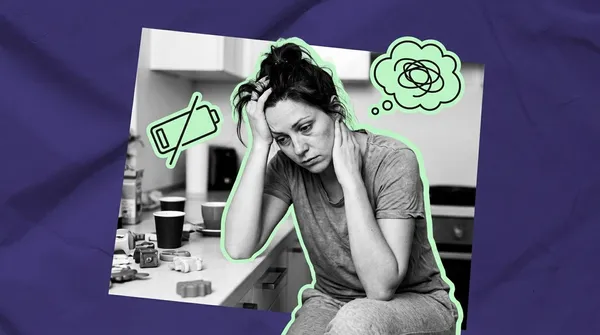
Last week was "one of those weeks": my twins made their First Holy Communion, my son had a baseball game, my daughter had a theater performance, there were teacher appreciation gifts to pull together, and my work week decided to be a complete fire drill. And in the middle of it all, my dad had major spinal surgery. I refreshed my phone between back-to-back meetings for surgical updates and drafted a teacher gift note somewhere between a Slack message and a calendar invite. Some weeks, keeping it all together is the whole accomplishment.
If that feeling sounds familiar, it's not because you're doing anything wrong — it's because there's simply too much to hold. This state of being has a name, and it's called burnout.
What is burnout (and why does it hit moms so hard?)
Burnout is chronic emotional, physical, and mental exhaustion caused by prolonged stress. Mom burnout, specifically, happens when caregiving demands consistently exceed your resources, and it's incredibly common. Research suggests that anywhere from 65% to 81% of working mothers report symptoms of burnout — including a Gallup and Motherly Annual State of Motherhood Study finding that 81% of working moms face burnout while attempting to "manage it all."
Stay-at-home moms aren't immune either. The stressors may look different (isolation, feeling undervalued, lack of adult interaction), but the exhaustion lands in the same place.
Why does burnout hit moms so hard? Because motherhood comes with invisible labor — the mental tracking of appointments, grocery lists, school forms, emotional needs, and a thousand tiny things no one else notices. It comes with societal expectations that say you should enjoy every moment. And it comes with virtually no "off" switch. You can't clock out of being a parent.
Perhaps the most damaging part is the normalization trap. We're told this is just what motherhood feels like, so we push through instead of seeking help. But there's a meaningful difference between the normal challenges of parenting and being genuinely burned out.
Signs of burnout: what does burnout feel like?
Burnout doesn't always announce itself dramatically. Sometimes it creeps in gradually until you realize you've been operating on fumes for months. Here are the key signs to watch for:
Emotional exhaustion: Feeling completely drained with nothing left to give, even after sleeping.
Detachment: Going through the motions of parenting without feeling present. Feeling disconnected from your kids, almost like you're watching yourself parent from the outside.
Reduced sense of accomplishment: Feeling like you're failing at everything, even when you're doing more than most people could handle.
Physical symptoms: Chronic fatigue, frequent headaches, getting sick more often, tension in your body that won't release.
Emotional indicators: Snapping over small things, feeling resentful toward your partner or kids, emotional numbness, or crying over something that normally wouldn't faze you.
Being tired improves with rest; burnout doesn't. If you took a full weekend off and still felt completely empty on Monday morning, that's not just tiredness. That's burnout talking.
What causes burnout in moms?
Burnout rarely has a single cause. It's usually a pile-up of factors that compound over time:
Relentless demands with no real breaks (parenting is genuinely 24/7)
Lack of support from partners, family, or community
Perfectionism and unrealistic expectations, both internal and external
The mental load: all the invisible planning, organizing, and remembering that falls disproportionately on moms, and can contribute to cognitive fog and mental overload
For working moms, juggling career and family without adequate support systems
For stay-at-home moms, isolation and the feeling of being undervalued
Burnout vs. depression: how to tell the difference
Burnout and depression can look a lot alike. Both involve exhaustion, low mood, and difficulty finding joy in things you used to love. But they're not the same thing, and understanding the difference matters for getting the right help.
Scope: Burnout is situational; it's tied specifically to your role as a mother and caregiver. Depression affects all areas of life, regardless of circumstances.
Timeline: Depression has specific diagnostic criteria, including symptoms lasting two or more weeks. Burnout doesn't follow a hard timeline; it builds gradually.
Treatment: Both respond well to therapy, but they may require different approaches and, in the case of depression, potentially medication.
The tricky part is that chronic, untreated burnout can actually lead to clinical depression. And you can have both at the same time. If you're unsure which you're dealing with, a therapist can help sort through it. What matters most is that you don't dismiss what you're feeling as "just part of being a mom."
In a Rescripted community survey of 596 new parents, sadness or depression was the most commonly cited emotional challenge at 59%, followed by anger or irritability at 21% and anxiety or worry at 20%. Together, those responses accounted for virtually every answer received. Almost no one said they were fine. The three emotions that dominated — feeling low, feeling reactive, feeling scared — are the same three that show up when someone is running on empty. Not adjusting. Not having a hard week. Actually depleted. The near-universality of that experience suggests this isn't an individual struggle. It's a shared one that doesn't get named often enough.
How long does burnout last? (And can it be permanent?)
There's no fixed timeline for burnout. How long it lasts depends on severity, how long it's been building, and, critically, whether you get help.
Without intervention, burnout can last months or even years. The good news? Burnout is not permanent with proper support and treatment. Recovery depends on reducing or removing stressors where possible, building a support system, and learning new coping skills.
Therapy significantly speeds recovery. Many people see meaningful improvement within six to eight weeks of consistent sessions. The earlier you seek help, the faster recovery tends to be. Waiting until you're completely depleted makes the climb back harder — not impossible, just longer.
Questions Women Are Asking
How to deal with burnout: what actually works
Acknowledging that you're burned out is the first (and hardest) step, and it's what opens the door to getting real help.
When you're drowning and need immediate relief:
Ask for one specific thing. Not "I need help" (too vague), but "Can you take the kids Saturday morning so I can be alone for three hours?"
Lower the bar. Survival mode is not failure. Cereal for dinner is fine. The laundry can wait.
Say no to one thing this week. Just one. The birthday party, the volunteer commitment, the extra project. Pick one and let it go.
For longer-term recovery:
Start therapy (more on this below; it's the most effective tool available)
Build support systems: friends, partner involvement, childcare help, or community
Set boundaries, even when it feels uncomfortable
Reduce mental load where possible (shared calendars, delegating, letting go of perfection)
Prioritize self-care that's actually restorative, not performative. A bubble bath is nice, but it doesn't fix systemic overwhelm. Rest, solitude, movement, and connection do.
BetterHelp's Motherhood With You video series features licensed therapists and real moms talking honestly about the emotional weight of motherhood — including what it actually looks like when you're running on empty. Watch the series here.
Therapy for burnout: why it's the most effective tool
Cognitive Behavioral Therapy (CBT) has strong evidence supporting its effectiveness for burnout recovery, with research showing it significantly reduces parental burnout symptoms. But why does therapy work when all the self-help books and Instagram advice don't quite cut it?
Therapy does what self-help can't. It helps you identify the root causes of your burnout (not just the symptoms), change deeply ingrained thought patterns that keep you stuck, and develop coping strategies that are sustainable and personalized to your life.

A good therapist can help you process the emotions you've been stuffing down, learn to set boundaries without guilt, and reclaim your identity beyond motherhood. Many women don't realize how much of their burnout stems from beliefs they didn't even know they were carrying — that they should be able to handle everything, that needing help is weakness, that their needs should always come last. If you're looking for a place to start, finding words that reflect what you're feeling can be a meaningful first step toward naming the experience.
Therapy isn't a luxury; it's essential healthcare for burnout. And yet, according to BetterHelp's 2026 State of Stigma report, 78% of women aren't accessing mental health care, and 47% of Millennials feel pressure to handle it on their own.
Platforms like BetterHelp make it more accessible and convenient, especially for moms who can't easily get to an office. And many people begin noticing improvement within six to eight weeks of consistent sessions. Individual experiences vary.
How to prevent burnout (for next time)
Once you've recovered, or even while you're recovering, building in prevention strategies makes a real difference:
Build in breaks before you crash, not after
Practice saying no earlier in the process, before your plate is overflowing
Do regular check-ins with yourself about your stress levels (a weekly "how am I really doing?" moment)
Maintain your support systems even when things feel manageable
Consider therapy as preventive care, not just crisis management
Hold realistic expectations: you genuinely do not have to do it all, and doing less doesn't make you less of a mother
You're not failing, you're burned out (and that's fixable)
If you've read this far and recognized yourself in these words, know that burnout does not mean you're a bad mom. It means the demands placed on you have exceeded what any one person can reasonably sustain. The system is broken, not you.
Getting help isn't a sign of weakness. It's one of the strongest things you can do, for yourself and for your family. A depleted parent can't pour from an empty cup, and you deserve to be filled back up.
Where to start? Talk to a therapist through a platform like BetterHelp, make an appointment with your doctor, or simply tell one trusted friend the truth about how you're feeling. Recovery is absolutely possible, and you don't have to figure it out alone. The fact that you're here, reading this, already means you're paying attention to what your mind and body are telling you. That's not failing. That's the first step toward getting better.